Homogeneous Equations
Homogeneous EquationsExpected Educational ResultsAlgebraFundamental Theorem of AlgebraTheorem: Fundamental Theorem of AlgebraCorollary: Fundamental Theorem of AlgebraSolving PolynomialsDistributive Property and Zero Product Property of Real NumbersQuadratic EquationsQuadratic-Like EquationsDefinition: Quadratic-Like EquationMethod to Solve Quadratic-Like EquationsFinding Zeros Using Rational Root Theorem and Polynomial or Synthetic DivisionFinding Zeros Using Synthetic DivisionPractice 01DeterminantsProperties of DeterminantsComputation of Determinants Matrix MatrixPractice 02CC BY-NC-SA 4.0
Author: John J Weber III, PhD Corresponding Textbook Sections:
- Section 4.2 – Homogeneous Linear Equations: The General Solution
Expected Educational Results
- Objective 10–1: I can identify if two or more functions are linearly-independent.
- Objective 10–2: I can identify the characteristic equation for -degree homogeneous linear ODEs.
- Objective 10–3: I can find the most general solution to -degree homogeneous linear ODEs.
Algebra
Fundamental Theorem of Algebra
Theorem: Fundamental Theorem of Algebra
A polynomial of degree , , , has exactly factors, counting multiplicities.
Corollary: Fundamental Theorem of Algebra
, where , has exactly solutions, counting multiplicities.
Solving Polynomials
Distributive Property and Zero Product Property of Real Numbers
Example 01
Example 02
Quadratic Equations
Example 03
Distributive Property and Zero Product Property of Real Numbers
Example 04
Distributive Property and Zero Product Property of Real Numbers
Example 05
Quadratic Formula
Quadratic-Like Equations
Definition: Quadratic-Like Equation
Quadratic-like equations have the form: .
Method to Solve Quadratic-Like Equations
- Let and substitute into the quadratic-like equation;
- Factor: , where \text{ and } ;
- Solve in terms of : ;
- Solve in terms of :
Example 06
Finding Zeros Using Rational Root Theorem and Polynomial or Synthetic Division
Given the polynomial
Let be the factors of . Let be the factors of . Then the set of potential rational roots of the polynomial are
Example 07
Find all three real roots of: .
The factors of are .
The factors of are .
Then the set of distinct potential rational roots of the polynomial are:
Now use polynomial or synthetic division to find the three factors.
Using Polynomial Division
a. Divide the polynomial by , i.e., divide by :
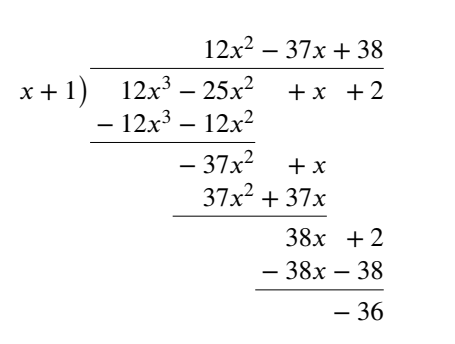
Since the above polynomial division has a non-zero remainder, then is not a factor of .
b. Divide the polynomial by , i.e., divide by :
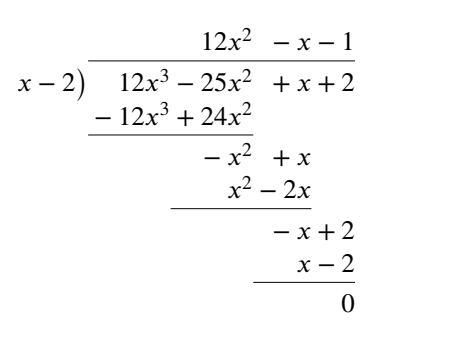
Since the above polynomial division has a zero remainder, then is a factor of .
c. Divide the polynomial by , i.e., divide by :
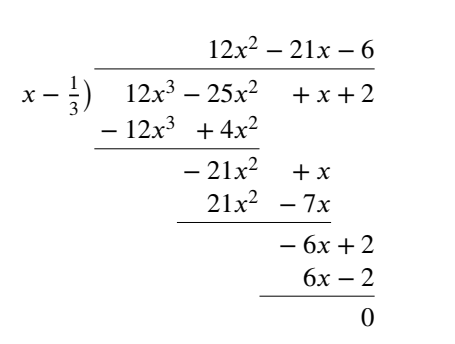
Since the above polynomial division has a zero remainder, then is a factor of .
d. Divide the polynomial by , i.e., divide by :
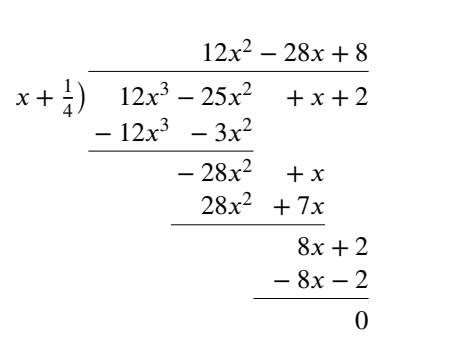
Since the above polynomial division has a zero remainder, then is a factor of .
Thus, .
Finding Zeros Using Synthetic Division
a. Divide the polynomial by , i.e., divide by :
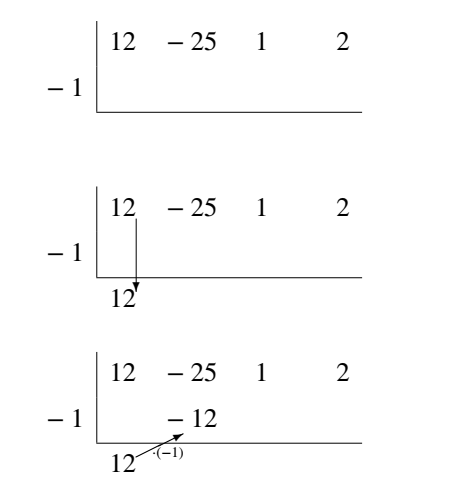
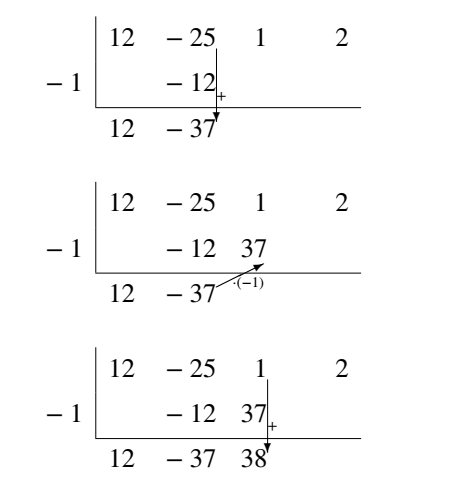
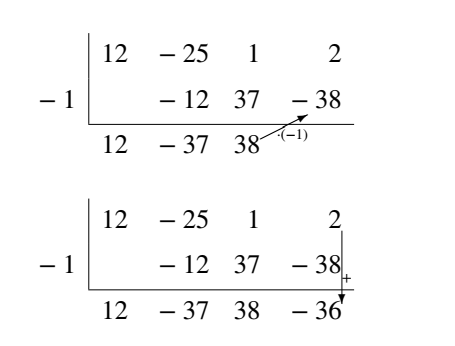
The steps above are provided to show the method of synthetic division. Your work should only look like the following:
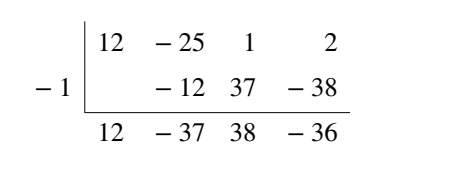
Since the above polynomial division has a non-zero remainder (the right-most number on the last row), then is not a factor of .
b. Divide the polynomial by , i.e., divide by :
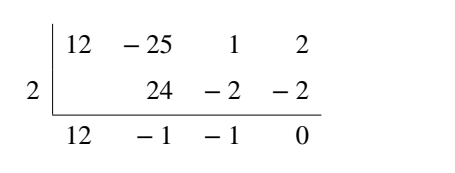
Since the above polynomial division has a zero remainder (the right-most number on the last row), then is a factor of .
c. Divide the polyomial by , i.e., divide by :
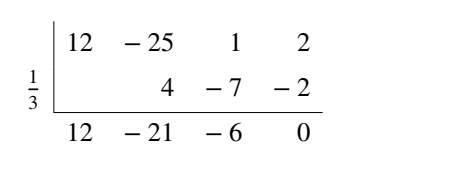
Since the above polynomial division has a zero remainder (the right-most number on the last row), then is a factor of .
d. Divide the polyomial by , i.e., divide by :
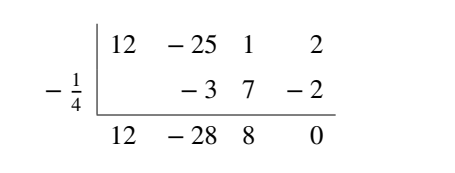
Since the above polynomial division has a zero remainder (the right-most number on the last row), then is a factor of .
Thus, .
Practice 01
Solve, i.e., find all solutions, to the following equations:
Determinants
Let be a square matrix. The determinant of is represented by det() or .
Properties of Determinants
If , then the following are all equivalent:
- the columns of are linearly dependent vectors in
- the rows of are linearly dependent vectors in
- the matrix is not invertible
- the system of linear equations either has no solution or infinitely-many solutions
If , then the following are all equivalent:
- the columns of are linearly independent vectors in
- the rows of are linearly independent vectors in
- the matrix is invertible
- the system of linear equations has a unique solution
Computation of Determinants
Matrix
Let
Then,
Matrix
Let
Then, using cofactors,
Practice 02
Find the determinants of the following matrices:
CC BY-NC-SA 4.0
This work is licensed under a Creative Commons Attribution-NonCommercial-ShareAlike 4.0 International License [http://creativecommons.org/licenses/by-nc-sa/4.0/].
Last Modified: Monday, 6 September 2020 13:33 EDT