Characteristic Equations with Complex Roots
Characteristic Equations with Complex RootsExpected Educational ResultsAlgebraTheorem: Fundamental Theorem of AlgebraCorollarySolving Polynomial EquationsDistributive Property and Zero Product Property of Complex NumbersQuadratic EquationsQuadratic FormulaDiscriminantQuadratic-Like EquationsMethod to Solve Quadratic-Like EquationsDifference of Two CubesSum of Two CubesFinding Zeros Using Rational Root Theorem and Polynomial or Synthetic DivisionPractice 01DeterminantsCC BY-NC-SA 4.0
Author: John J Weber III, PhD Corresponding Textbook Sections:
Section 4.3 – Auxiliary Equations with Complex Roots
Expected Educational Results
Objective 11–1: I can identify complex solutions to the characteristic equation for
Objective 11–2: I understand the form of the solution to an
Objective 11–3: I can find the most general solution to
Objective 11–4: I can find the solution to
Algebra
Theorem: Fundamental Theorem of Algebra
A polynomial of degree
Corollary
By Fundamental Theorem of Algebra,
Solving Polynomial Equations
Distributive Property and Zero Product Property of Complex Numbers
*Example 01
Quadratic Equations
Quadratic Formula
Discriminant
The discriminant of a quadratic equation
The discriminant is used to determine the types of roots to a quadratic equation:
If
If
If
Example 02
Quadratic-Like Equations
A quadratic-like equation has the form:
Method to Solve Quadratic-Like Equations
Let
Factor
Solve in terms of
Solve in terms of
Example 03
In order to write the solutions in standard cartesian form, we will need to use technology. For example, in Mathematica:
x1(* real part of sqrt((-3-i*sqrt(5))\2) *)2Re[Sqrt[(-3-I*Sqrt[5])\2]3
4(* imaginary part of sqrt((-3-i*sqrt(5))\2) *)5Im[Sqrt[(-3-I*Sqrt[5])\2]Difference of Two Cubes
Example 06
Sum of Two Cubes
Finding Zeros Using Rational Root Theorem and Polynomial or Synthetic Division
Given the polynomial
Let
Example 04
Find all three real roots of:
The factors of
The factors of
Then the set of distinct potential rational roots of the polynomial are:
Now use polynomial or synthetic division to find the three factors.
Using Polynomial Division
a. Divide the polynomial by
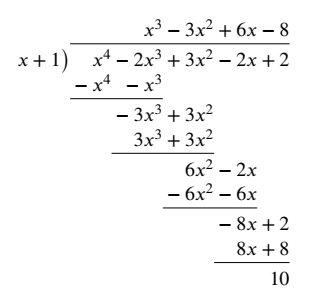
Since the above polynomial division has a non-zero remainder, then
The same is true for all the other potential rational roots. Thus, there are no real solutions to the polynomial equation.
Since all roots are non-real numbers, we will need a method for solving a quartic (
NOTE: Potential methods for solving polynomial equations that have only complex roots:
Substitute
Muller's method;
Numerical methods to approximate the complex roots;
If one of the complex roots is known, then polynomial or synthetic division can be used to reduce the degree of the polynomial.
Thus, we will will use technology to compute all roots of polynomial equations.
Practice 01
Solve, i.e., find all solutions, to the following equations:
Determinants
See: PRE_10_Homogeneous_Equations.html.
CC BY-NC-SA 4.0
This work is licensed under a Creative Commons Attribution-NonCommercial-ShareAlike 4.0 International License [http://creativecommons.org/licenses/by-nc-sa/4.0/].
Last Modified: Monday, 6 September 2020 13:33 EDT